
The Second Intermediate Period
Although Senusret’s successors apparently maintained and embellished his works they did not substantially alter the site. With the breakdown of central authority during the Second Intermediate Period and the political fragmentation of the country, none of the local rulers could command the resources for major building projects. The odd bit of inscribed building material along with some statuary and stelae has survived as fill in later constructions. Late in the period there is a resurgence in Theban power as the rulers of the Seventeenth Dynasty made a strong bid to expel the alien Hyksos rulers of the Delta and reunite the country. They were ultimately successful but were apparently too preoccupied with the political struggle to have had much of an impact on the site.
Ahmose I (1570-1546 BC)
Late in the period there is a resurgence in Theban power as the rulers of the Seventeenth Dynasty made a strong bid to expel the alien Hyksos rulers of the Delta and reunite the country. They were ultimately successful but were far too preoccupied with war to have had much of an impact on the site. Seqenenre Tao II began the struggle but both he and his son Kamose died in battle. In the end it was his second son, Ahmose—a mere boy when he became pharaoh—who eventually 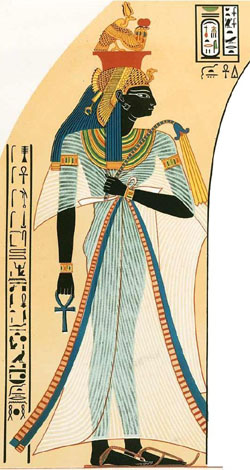 captured the Hyksos capital at Avaris in the eastern Delta and drove the foreigners out of the country and back into Western Asia from whence they had come. He was considered by later Egyptians as a new founder of the country and the first of a new line of kings, the Eighteenth Dynasty.
In order to keep potential enemies at a distance Ahmose and his immediate successors adopted an aggressive foreign policy, launching regular campaigns into Canaan and Nubia. As a result of these large-scale plundering expeditions unprecedented amounts of wealth flowed into the kingdom and a good deal of that found its way into the coffers of the gods of Egypt, especially those of Amun. In the eyes of the pharaohs, their victories were Amun’s victories and it was right that he be properly rewarded.
To continue to rule, it was absolutely necessary that the new dynasty identify itself with the divine order. Each pharaoh was considered to be quite literally the ‘son’ of the god—despite his actual parentage—and his divine birth was celebrated every year. Ahmose was the first to install his wife, Ahmose-Nefertari (left), as God’s Wife of Amun, a position of immense wealth and power. Her main role was to play the part of Mut in religious ceremonies and, through intercourse with the god, to produce the next pharaoh. This strengthened the legitimacy of the dynastic line, especially since she was the pharaoh’s sister. Ahmose-Nefertari was apparently a full partner in 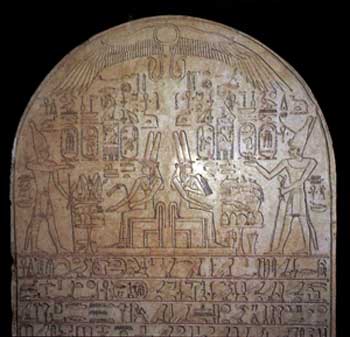 the regime of her husband/brother and served as regent for their young son Amenhotep when he succeeded to the throne. Her inscriptions have been found from one end of the country to the other and she was worshipped as a goddess.
These religious ceremonies and the various major festivals held at different times throughout the country went a long way towards binding the country together and cementing the power and prestige of the pharaoh. It was important that the venues where they took place—the temples and the processional ways—should be as magnificent as possible in order to get the maximum propaganda value. A stele found at Karnak and dating to year 18 of his reign records the dedication of gold and silver drinking cups, gold and silver libation vessels, gold offering tables and jewellery, musical instruments, and a wooden boat to Amun. However, apart from an inscribed lintel, nothing remains of any building activity undertaken by Ahmose at the site—military affairs still commanded most of his time and energy.
Amenhotep I (1551-1524 BC)
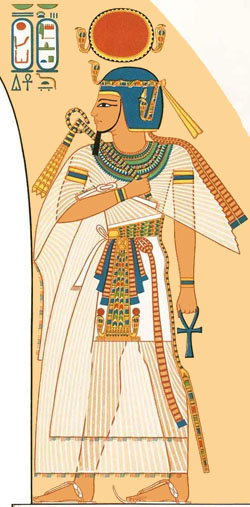 Like his father before him, Amenhotep was very young when he succeeded to the throne and his mother, Ahmose-Nefertari served as regent for a short time at least. The early part of his reign saw a continuation of the aggressive foreign policy of his father. His campaigns in the south, in particular, greatly increased the revenues of the state. Nubia was the source of most of Egypt’s gold. With Egypt’s neighbours subdued, the pharaoh was able to divert the manpower resources of the state to more peaceful enterprises and the most important of these was the restoration and expansion of the major temples.
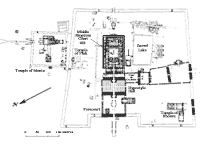
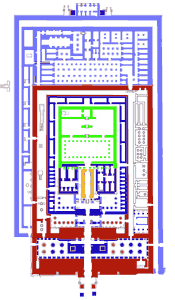
He built at a number of sites but nowhere was more important than Karnak. He does not appear to have made any substantial alterations to the temple itself but he did add a large forecourt area to the front (west) of the building. Presumably there was monumental gateway too but no trace of it has been found. We know there was one on the southern approach because the tomb biography of Ineni, Amenhotep’s chief architect, mentions a limestone gateway of 20 cubits on the south side of the site. Blocks from this gateway have been recovered from the Court of the Cachette and these depict scenes from his sed-festival. A colossal limestone statue of the pharaoh found in the vicinity probably stood outside it (it is now located in front of Pylon VIII. Excavations in the area between Pylons VIII and IX have uncovered the remains of a mud brick pylon on the same axis—possibly the one that Tuthmosis III replaced in stone some fifty years later.
He enclosed the old Middle Kingdom temple with a new limestone wall that had a number of chapels built up against the inside face. These were later dismantled by Tuthmosis 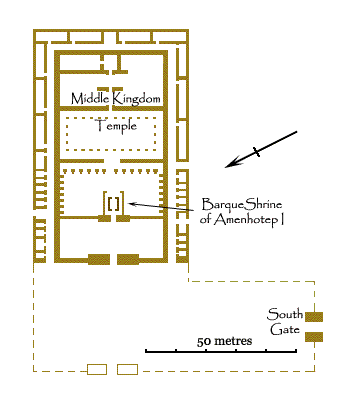 III but some of the inscribed blocks and lintels have been found in the Court of the Cachette. The stonework was decorated with reliefs of the pharaoh, accompanied by his mother, making offerings to Amun-Re. Tuthmosis rebuilt the chapels in sandstone and, according to his inscriptions, he placed statues of himself and his royal ancestors within them, so presumably the served the same purpose in the earlier version.
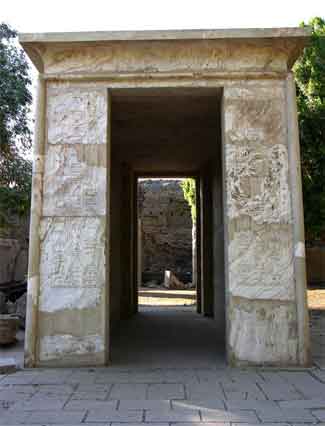
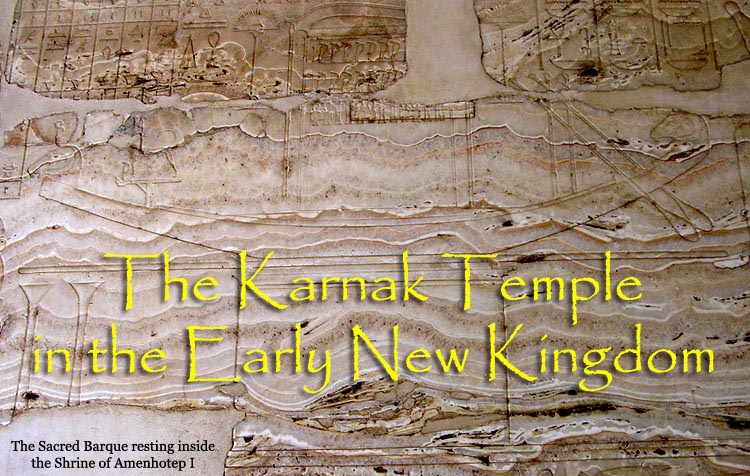
The only building of his that is still visible at Karnak (because it has recently been reconstructed in the Open Air Museum out of blocks found in Pylon III) is a calcite barque chapel. It is a small building (6.75 metres long, 3.6 metres wide and 4.5 metres tall), originally nestled between a pair of screen walls, with solid side walls and doorways at both ends. According to the inscriptions, the latter were originally fitted with double leaved doors of solid copper (although wood sheathed in copper seems more likely) and decorated with gold figures. The building was decorated inside and out with reliefs, including (on the inside) the earliest surviving depiction of the sacred barque itself. There has been some debate as to where the chapel originally stood. One suggestion that has received wide support is that it was located west ofthe Sacred Lake, near where  the Seventh Pylon was later built and where a similar shrine built byTuthmosis III now stands—bothstructures had the same name (‘Amun, Enduring of Monuments’). However, it is now generally believed that it was moved there by Hatshepsut from the spot now occupied by the shrine of Philip Arrhidaeus (and, before that, her own barque shrine).
In addition to his other works, Amenhotep also built a jubilee pavilion that was almost identical to the White Chapel of Senusret I right down to the style of relief carving, which is so similar that it is sometimes impossible to distinguish them. Like so many others, this building was demolished by Amenhotep III and the stone used as ballast in the Third Pylon. Its original location is unknown but a site alongside the southern approach is generally favoured.
The location of his tomb is uncertain but he was worshipped as a deity, along with his mother, at the tomb workers village that he founded at Deir el-Medina. These were the men who excavated and decorated the royal tombs in the Valley of the Kings and there is a small tomb there (KV39) that may have been his. There are other candidates however.
Suggested Reading:
| Blyth, Elizabeth | 2006 | Karnak, The Evolution of a Temple |
| Dorman, Peter F. & Betsy M. Bryon | 2007 | Sacred Space & Sacred Function in Ancient Thebes. Studies in Oriental Civilization No. 61. Oriental Institute. Unversity of Chicago |
| Strudwick, Nigel & Helen | 1999 | Thebes in Egypt |
