

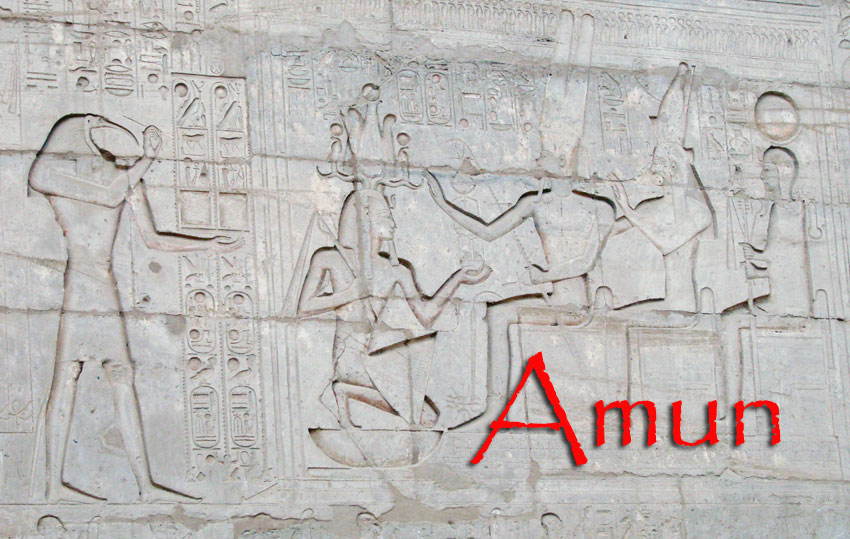
In Ramesses’ day, Amun was by far the most powerful god in Egypt, the god of kingship and king of the gods, but he began his career as a somewhat obscure and relatively minor deity.
His name first occurs in the Pyramid Texts of Dynasty V and he figures in the Old Kingdom creation myth known as the Ogdoad of Hermopolis as one of the eight deities, four male and four  female, that represent the abstract concepts out of which the world was created. Amun means ‘the hidden one’ and, along with his female counterpart Amunet, was a deity of the air or breath—the ‘breath of life’—but otherwise little is known. This creative aspect remained a part of his nature even as his identity changed over the centuries. The goose was sacred to him because, in one version of the creation myth, an egg was laid on the original mound of creation by the celestial goose (‘the great cackler’) out of which hatched the sun-god Ra, the first of the gods. He is described as Amun Kamutef (the ‘bull of his mother’) who created himself by impregnating his mother (and was thus his own father).
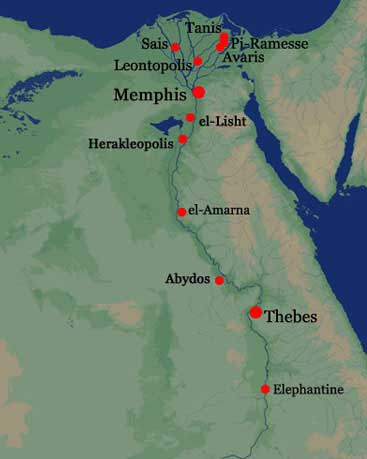
His importance increased dramatically in the Middle Kingdom period (roughly 2040-1782 BC) with the rise to power of a line of rulers from the Upper Egyptian city of Thebes who reunited the country after the chaos of the First Intermediate Period. Thebes is the name that the Greeks gave to the town of Waset (‘Sceptre’) the provincial capital of the nome of the same name. Although the original god of Thebes was probably the warrior-god Montu and several of the Eleventh Dynasty pharaohs bore the name Mentuhotep (‘Montu is content’). However, the last Mentuhotep was overthrown by his vizier, Amenemhat, the founder of the Twelfth Dynasty. As his name (‘Amun is at the Head’) suggests, he was an adherent of Amun and henceforth the power of the god increases dramatically while that of Montu begins to fade. The earliest identifiable remains at the great cult centre of Karnak, including the White Chapel, date to this period.
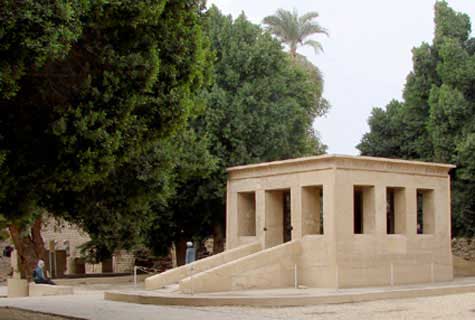
White Chapel of Senwosret I
During the Second Intermediate Period (1782-1570 BC) a native dynasty managed to hang onto power in Thebes while the alien Hyksos took over the Delta. In time they managed to throw the Hyksos out of Egypt and establish themselves throughout the kingdom as the Eighteenth Dynasty and found what is known today as the New Kingdom (1570-1070 BC). It was Amun who led them 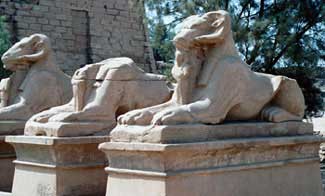 to victory over the Hyksos and their Nubian allies and drove them out of Egypt. Under his leadership the Egyptians expanded their empire southwards up the Nile and northwards into the Levant. Huge amounts of plunder and tribute flowed into his coffers and extensive estates were granted to him. His temples,
  especially Karnak, were by far the wealthiest in the land.
By this time he has acquired the attributes of a fertility god and is closely identified with the ithyphallic god Min (right). He was also closely associated with the ram, which is noted for its belligerency as well as its sexual potency. The processional ways leading to his temple at Karnak were lined with ram-headed sphinxes. However, Amun himself was never depicted as a ram or as ram-headed— not until the Late Period, at any rate, and then probably because of Nubian influence.
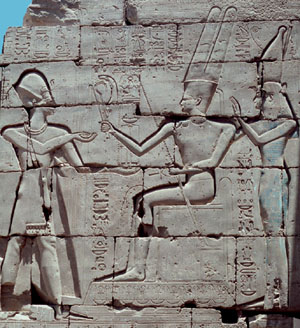
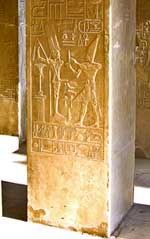
He is generally depicted wearing a cap surmounted by a pair of tall plumes, probably the tail feathers of a hawk and symbolic of his association with the air. His original partner, Amunet, has largely disappeared from the scene by this 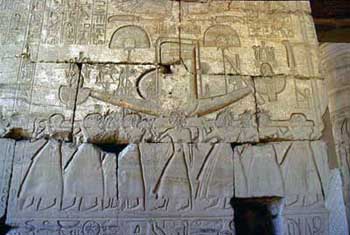 time. Instead, the mother goddess Mut was his consort and the moon god Khons their son. Their temples were closely linked at Karnak and their joint festival, the Beautiful Feast of Opet, when the statue of the god was paraded through the streets (right) was by far the biggest show in town.
Over the course of New Kingdom period, temples were built in his honour throughout the land, from Nubia to the Delta—making him the first truly national god. In many cases the local god was displaced or reduced to the status of a dependent with only a small shrine in the temple of his lord and master. Some gods were too powerful to displace but Amun’s priests often bore such titles as ‘Chief Priest of Ptah’ or ‘Chief Priest of Ra,’ and claimed jurisdiction over their cults. His temple at Karnak was considered the site of the Primeval Mound, where creation began. He was the divine father of the king, replacing Ra in that role, through intercourse with the ‘God’s Wife of Amun’—as depicted at Deir el-Bahri and Luxor.
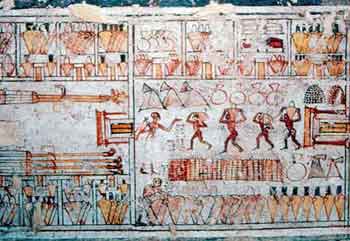 By the reign of Amenhotep III, the estates of the god consisted of huge tracts of the best farmland in all parts of the country and were second only to those of the king. He had his own fleet to transport their produce to his granaries and storehouses at Karnak. Hundreds of craftsmen were employed in his workshops to make furniture, ritual vessels, jewellery and all the other paraphernalia needed for the cult. Apart from a brief reaction known as the Amarna Revolution, Amun’s economic and political power continued to rise throughout the New Kingdom period but began to wane with the fortunes of the old capital city during the Third Intermediate Period (1070-712 BC). The country was once again divided and, although the Nubian rulers who eventually took over Thebes revered Amun greatly they were unable to reverse the decline. In the rest of Egypt the cult of Osiris and Isis rapidly displaced that of Amun in popularity and he eventually became a mere aspect of Horus.
