
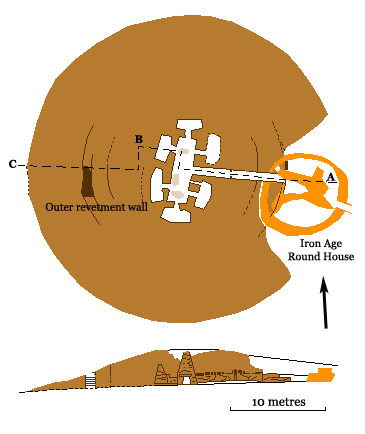
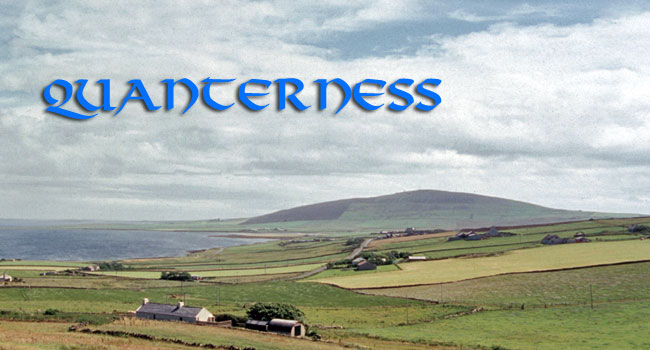
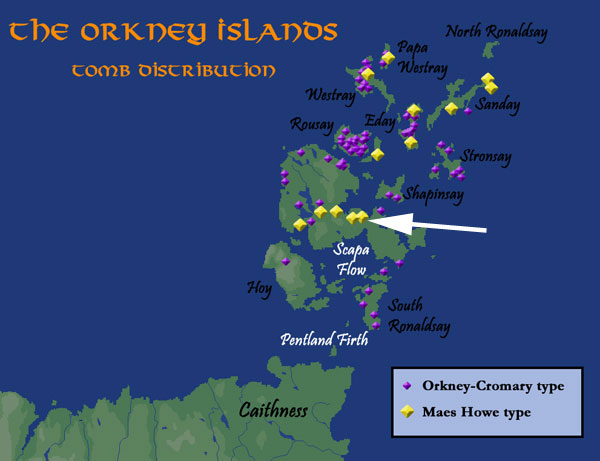
The tomb lies on the lower slope of Wideford Hill, below the smaller tomb named after it (the hill that is). It was opened in the early 19th century but its contents remained undisturbed until the site was reinvestigated by Colin Renfrew in 1972. The cairn is a large one (D= 31 metres and surviving to a height of about 3 metres) and included at least two concentric revetment walls within it. A short stretch of the outer wall was uncovered on the west side of the cairn. It turned out to be a double wall with an inner and an outer face 1.3 metres apart.
The entrance lay on the east it has been somewhat damaged by the intrusion of a later Iron Age house but the floor of the passage survives. The inner part is roofed at a height of 70 cm. from the inner revetment to the burial chamber but it is impossible to say whether or not it was roofed for its entire length of 9.4 metres.
The chamber runs roughly north-south and measures 1.8 X 6.4 metres. The lowest course of the masonry consisted of massive blocks, used to support the heavy lintels for each of the entrances to the side cells, but above that was a corbelled roof of lighter stone. When the site was investigated by George Barry in the early 1800’s, the roof was intact and stood at a height of 3.5 metres above the floor deposits. These were up the 30 cm. deep and were largely undisturbed when investigated by Renfrew.
There are six side cells symmetrically arranged with two along each long side and one at each end. They are much broader than they are deep Four of them still have their roofs—stone lintels set on edge about 2.25-2.5 metres above the floor. The SW cell was used by Barry to access the interior and was later filled with rubble. It is the only one to have been completely excavated—the others were reserved by Renfrew for future excavations. A unique feature is a small window between one of the cells and the main chamber—presumably serving some ritual function.
The deposits in the main chamber and SW cell are very similar. Above the bedrock was a thin layer of burnt material where fires had been lit. After this episode, three pits were dug and two of these were investigated in 1972. The southern one contained a crouched skeleton covered by slabs while in the central a similar burial had been placed in a stone-lined cist. Barry mentions finding a complete skeleton lying on top of the fill in one of the cells. The pits were sealed by three further layers of deposit which contained about 90% of the bone recovered from the tomb. The remains of at least 157 individuals—85 adults, 36 adolescents, 26 children and 10 infants—were found scattered throughout the tomb. Much of the bone was broken and they were rarely found in articulation—some of them showed evidence of burning. If you take the unexcavated parts of the tomb into account there was probably something on the order of 400 interments altogether.
Wood fires were lit from time to time in the upper levels and some of the bone showed evidence of burning. Among the animal bones were those of cattle and sheep that were probably brought in as joints of meat. Artefacts mixed in with the bone included Grooved Ware sherds, domestic tools and an antler hammer.
Since the 1972 excavations, the site has been backfilled and closed to the public in order to preserve it for future research. So no pictures.
