


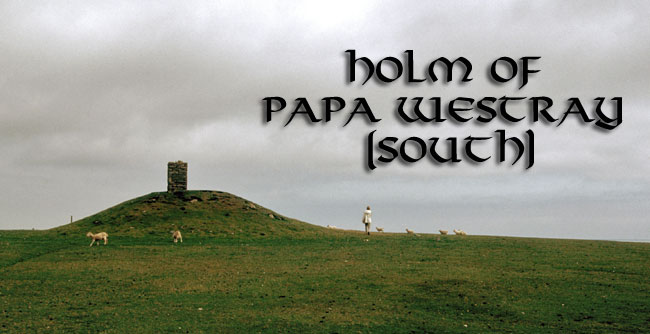
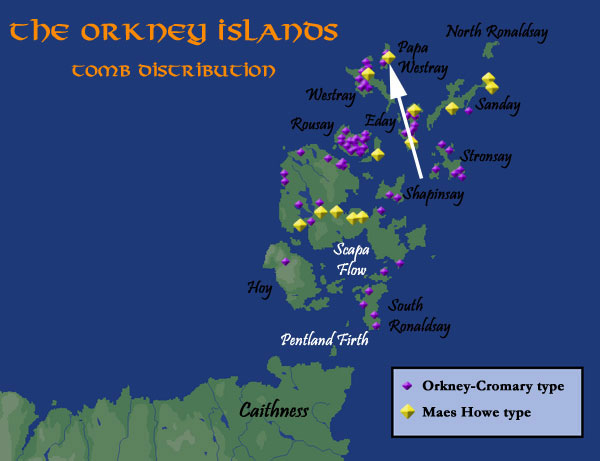
Holm of Papa Westray is a small islet just off the east coast of Papa Westray itself. There is little doubt that the two islands were once joined—they almost touch now at low tide. The cairn is at the highest point on the holm, about 15 m.a.s.l. and was cleared in the 1840’s. It lay open until 1930 when a concrete roof was added to protect the interior.
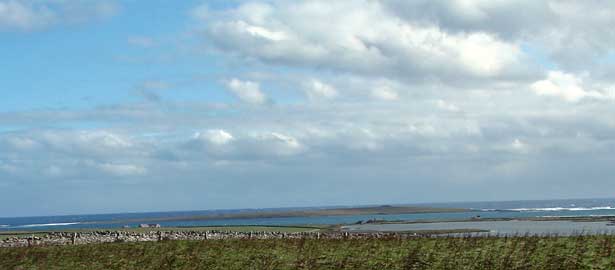
Holm of Papa Westray. The bump right of centre is the tomb
The tomb is oblong, about 38 x 19½ metres and runs roughly north-south. It survives to a height of 3 metres and probably never stood much taller than that. The entrance is on the east side and runs 9.1 metres, intersecting the burial chamber at roughly the mid point of the long axis. However, Captain F. W. L. Thomas, the original investigator, describes the passage as being only 5½ metres long. It would seem that some reconstruction was done in 1930 but on what basis is unknown. Only the innermost part of the passage, a stretch 3.8 metres long, is roofed at a height of about 60 cm.
The main burial chamber is 13.5 metres long but there are extensions at either end that bring the total to 20.4 metres. The width varies from 1.2 to 1.4 metres. When first exposed, the walls were up to 2.7 metre high—the side walls were corbelled from a little over halfway up to reduce the span of the ceiling to about 80 cm. There are 12 small entrances to side cells (including two with double cells). These range from 1.2 to 1.6 metres wide, 0.8 to 1.1 metres deep and 1.1 to 1.7 metres high. These were said to have been partially filled with rubble containing animal bones, but these have long since disappeared. No human bone nor artefacts were found but a number of the stones in the burial chamber were decorated with cup marks, concentric circles and other designs.
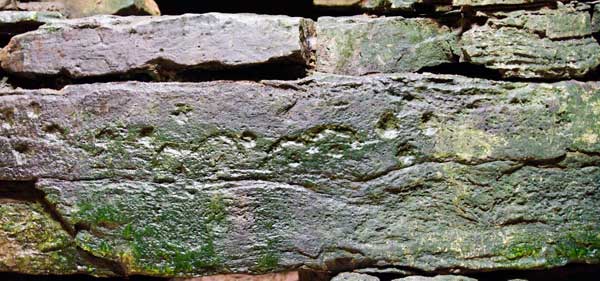
Carved designs in Holm of Papa Westray South
