
ORKNEY-CROMARTY TOMBS
There is evidence of funerary practices and other ritual activity at a number of tombs. Deposits of ash and charcoal have been found in burial chambers along with cremated human bone, broken pottery vessels, flint tools and animal bones. Unfortunately, excavation and recording standards in the past have meant that, in most cases, this material was either missed or ignored. One thing that has emerged is the fact that fire was apparently an important part of the funeral ritual since there is clear evidence of burning inside several of the tomb chambers. It is also clear that ritual activity was not confined to the interior of the tomb. At Knowe of Craie on Rousay a small hollow containing ash with fragments of burnt bone, flint chips and potsherds was found just outside the entrance. Undoubtedly similar features existed at many if not all of the other sites but, unfortunately, it is the sort of feature that is unlikely to survive undisturbed and if it does, would have been all too easily overlooked by Victorian excavators.
It would seem that, at some of the cairns at least, the final ritual involved filling the chambers and passages with rubble. Many tombs were clearly infilled before they were finally abandoned and that was probably the case with the rest of them as well. If so, this would have disturbed whatever cultural material they contained. It is important to remember that the tombs were revisited and used for several centuries before they were finally sealed, and that the finds represent the state of the chamber at the end of this period—either a steady accumulation of material or the final episode in a series of episodes.
Human Remains
Due to the acidic soil conditions, bone is rather poorly preserved in most Orcadian tombs. Some chambers contained very little or none at all while elsewhere it only survives on paved floors or 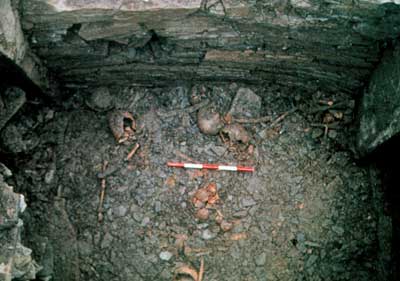 shelves. Even so, it is clear that there were wide differences from tomb to tomb in the number of individuals interred. There can be as few as two or three and as many as several hundred. Analysis of the material is hampered by the fact that most of what has survived was recovered in Victorian times and there is virtually no record of the circumstances of their recovery.
In cases where the bones have been analyzed, all age and sex groups are represented—males and females, adults, adolescents and children as young as two years old. Life expectancy in Neolithic Orkney was something on the order of twenty to twenty-five years—a very young population. Life was hard and the bones show evidence of osteoarthritis and degenerative disease of the spine, the result of carrying heavy loads.
Among the tombs that have been more thoroughly examined there seems to be some variation in the treatment of the deceased. While there were a number of articulated skeletons at some sites, meaning the bodies were intact when they were placed inside, the majority of the remains are fragmentary and incomplete. In some cases, special treatment was accorded to the skulls of the deceased, which were kept separate from the rest of the remains. The intact burials were found in the crouched position, lying on benches or shelves, while the rest of the bones were either gathered
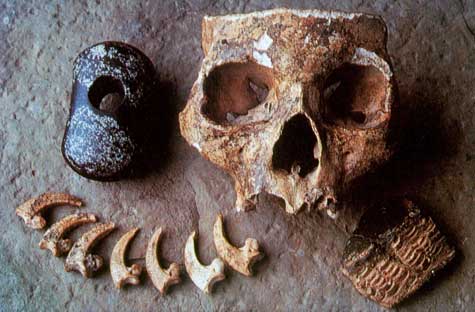
Isbister. Skull along with a rim sherd of Unstan ware, sea-eagle talons & a polished stone macehead
into heaps or placed in the end compartments or cells. The usual interpretation is that the latter represented the remains of earlier burials that were swept aside to make room for the latest arrivals. However, it is possible that at some sites the bodies of the deceased had been exposed somewhere else until the flesh rotted away. The loose bones were then collected and brought to the tomb. This process is known as excarnation and would explain why many of the smaller bones are missing. Of course, it is also possible that relics such as these were removed from the cairn for ritual or ceremonial purposes long after the original burial.
Animal Remains
Animal bones have been found in 11 chambers but they are normally not numerous nor have they been thoroughly studied except at Isbister. They represent mainly sheep and cattle but there is some red deer as well. From the types of bones that survive it would appear that joints meat were brought into the chamber, presumably as food offerings. Isbister also produced the remains of at least 8 sea eagles, which may have been the totem animal of that particular group, and an abundance of fish bones. Elsewhere, the animals are generally the same but with different species dominating the assemblage at different sites.
Artefacts
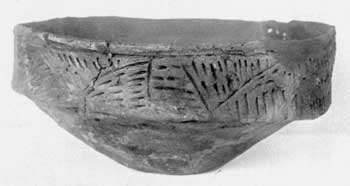
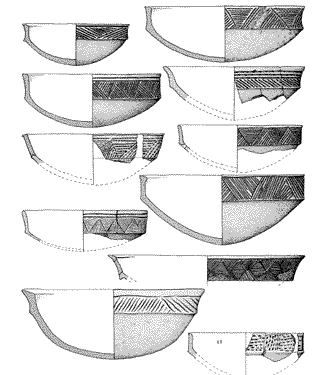 Grave goods are not exactly plentiful and consist largely of broken pottery, including Unstan ware (examples from Unstan, right), along with some flint. Since sherds from complete vessels are very rare, either some of them were subsequently removed or the pots were broken elsewhere. They presumably held food and drink but for whom remains a mystery—possibly to sustain the deceased in the afterlife or to propitiate the spirits of the dead. Alternatively, it may have been consumed by the mourners at the deceased’s wake.
While the amount of pottery varies from tomb to tomb, Unstan Ware is typical of stalled cairns and other tombs of the Orkney-Cromarty tradition. The most distinctive shape is a shallow, round-based bowl with a fairly high collared rim. The rim is often decorated with patterns of slanting lines or triangles made by incision or stab-and-drag. The largest collections come from Unstan itself, from Isbister and from Taversoe Tuick, and include many plain bowls and jars with simple rims. The latter are more functional and not as well made as the decorated vessels. They probably represent everyday ware while the finer vessels were reserved for ritual purposes. The pottery found at Isbister contained some forms not found elsewhere and may be later than that found elsewhere.
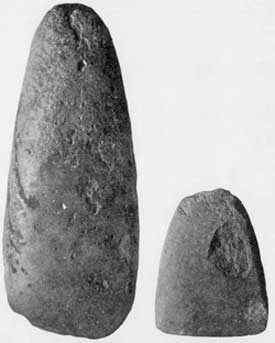
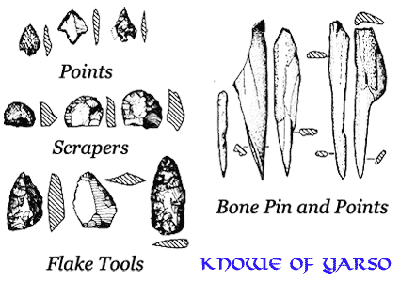 Other small finds include stone axes, fine flint knives and leaf-shaped arrowheads. These items were probably deliberately placed in the tomb but it is difficult to be sure with some of the other material, mostly everyday flint implements—blades, scrapers, etc.—that might have been accidentally introduced (midden material?). Personal objects—bone pins, shell necklaces and that sort of thing—are extremely rare for the period that the tomb was in use. However, they have been found in the passageway or in the fill associated with the blocking of the tomb. It is difficult to say whether their inclusion was accidental or not. What is certain is that much if not all of it tends to be associated with Grooved Ware and is therefore later.
MAES HOWE TOMBS
Human Remains
As is the case with the stalled cairns, there is a real discrepancy in the amount of human remains recovered from Maes Howe tombs. A few have none at all while most of the rest have no more than a couple of dozen—perhaps the result of soil conditions and later disturbance. Quanterness, on the other hand, contained the bones of not less than 157 individuals. Some 20% of the main chamber is still unexcavated along with 5 of the 6 cells, which would suggest that the actual total was considerably larger—perhaps something on the order of 400. The bones were in very poor condition and complete skeletons are rare but two have been found in pits dug into the floor of the chamber during the earliest phase of use. There was clear evidence of fire after which the floor of the chamber and at least one of the cells was covered by a ‘bone spread’ some 30 cm. deep made up of bones mixed with earth and stones. This bone spread accumulated over the course of many generations and there was evidence of burning throughout. Only in the uppermost levels could body parts be identified and it was here that the only complete skeleton was found. The ages of the individuals ranged from 8 months to about 50 years with slightly more males than females. As is the case with the earlier tombs, many bones were missing from the assemblage but in this case there are surprisingly few skull fragments. This suggested to Colin Renfrew, the excavator, that excarnation was practiced.
Animal Remains
As far as animal remains are concerned, they are found mixed with the human remains at Quanterness—but only in the chamber and not in the cells. The bones mainly belong to sheep along with some cattle and deer, and are consistent with joints of meat being placed in the tomb as food offerings. The most significant find from the other sites is the collection of 24 dog skulls found at Cuween Hill.
Artefacts
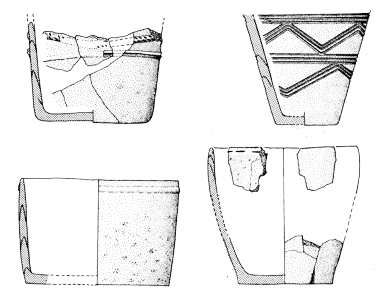
Only four tombs have produced anything in the way of artefacts and the material from Cuween Hill and Eday Manse has disappeared. At Quanterness there were sherds from at least 34 pots, all of it Grooved Ware—typically flat-bottomed jars and bowls with fairly straight sides. Only a few of them had been decorated but the patterns are standard—incised geometric patterns that include chevrons and triangles.
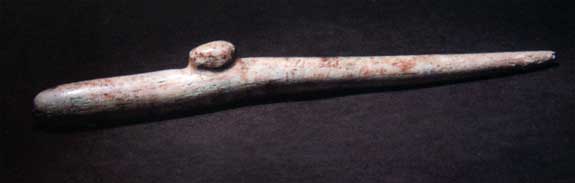
Quoyness. Bone Pin
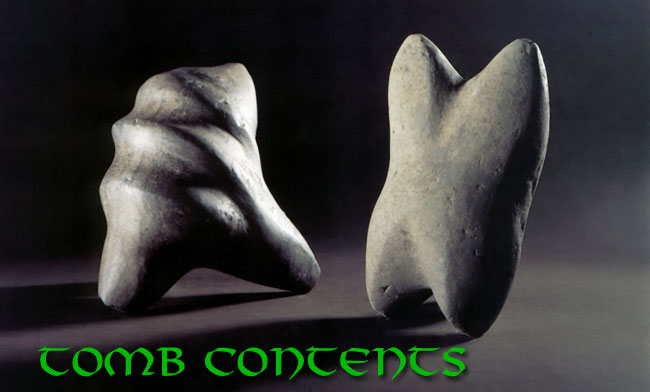
The other small finds are pretty nondescript, consisting mainly of utilitarian objects of stone and bone—flint and ground stone tools along with some bone pins. There is the odd exception, however, such as the spiked stone objects from Quoyness (see the top of the page) and the stone ball (now missing) reported to have been found at Cuween Hill.
Art
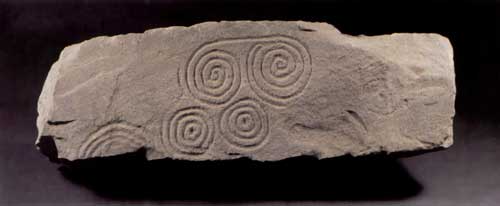
Decorated Stone. Eday Manse
Decorated stones have been found at three sites. Simple pecked designs have been found on a number of places on the walls of Holm of Papa Westray South. The most complex motif looks like pairs of eyes but there are circles and small cupmarks as well. At Eday Manse, the designs, which appear on a single stone, are more elaborate and much more carefully executed (right). They are curvilinear rather than geometric and include spirals along with concentric arcs and circles. There are three decorated stones from Pierowall where the main motif is linked spirals—very reminiscent of designs found in the Boyne Valley tombs of Ireland and the passage graves of Brittany.
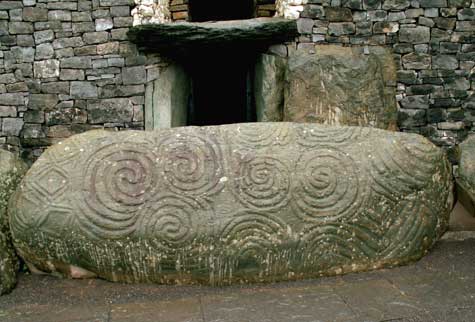
Newgrange (Ireland). Decorated Stone
