| |
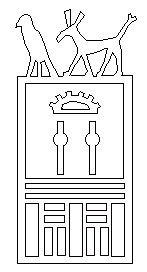
| DJOSER
& IMHOTEP |
| |
| When
the pharaoh Djoser (2630–2611 BC) took the throne
of Egypt nearly five thousand years ago, Egypt was still
a new country with a somewhat delicate constitution.
It had been forged about four hundred or so years earlier
when the legendary Menes, the ruler of the Nile Valley,
conquered the Delta of the Nile and hammered together
a single kingdom. The union was a fragile one, however,
and the forces of separatism remained strong. The years
before Djoser came to the throne were apparently characterized
by rival pharaohs and civil war the royal cemeteries
show signs of massive destruction and burning—but
eventually the Land was reunited by a pharaoh known
as Khasekhemwy (“Appearance of the Two Powers”)
who seems to have died without male issue. |
| |
| When
he died, the
throne passed to a man named Sanakht (“Strong
Protection”) who had probably married the old
king's daughter in order to legitimize his claim. He
founded a new dynasty, the third, and fought hard to
consolidate his hold on the country. Djoser seems to
have been a younger brother and came to the throne about
18 years later. Since his immediate predecessors had
pacified the country militarily, Djoser turned his attention
to the political side and aimed to give his people a
sense of national unity and pride. He decided to build
an enormous monument to symbolize the unity of the land
and give all of its citizens a sense of common purpose.
This was to be expressed in the construction of the
royal tomb which was designed to surpass in scale and
splendour any previous such monument. It was to be built
entirely out of stone, instead of the usual mud-brick,
to symbolize the permanence of the new order. Even the
wooden elements and trimwork were to be of stone. The
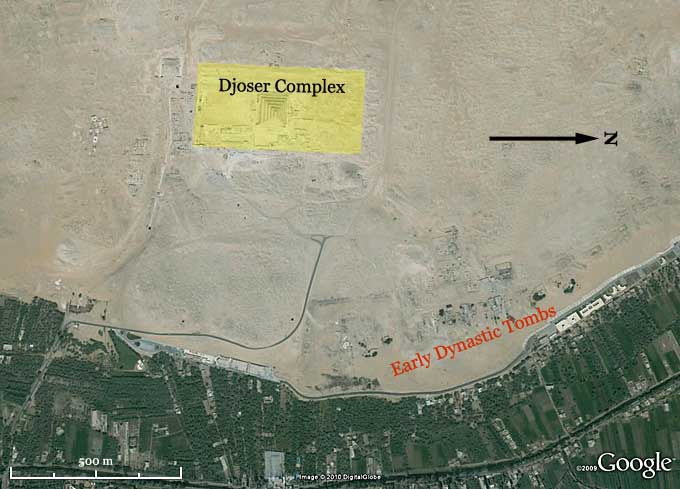
end result was a enormous complex, covering an area
of over 15 hectares (544 x 277 metres), built on the
highest part of the site. It combined elements of earlier
tombs and and funerary palaces, bringing them together
on a grand scale. |
| |
|
Step
Pyramid from the West |
| |
| The
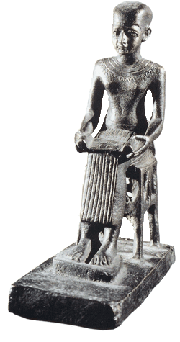
man made responsible for carrying out the project was
his vizier Imhotep, who was worshipped as a god by later
Egyptians because of his genius and vision. The final
product turned out to be an entirely new type of monument,
a step pyramid, but that was apparently not the original
goal of the architect. Clearance along the base of the
pyramid on its south side have shown that the first
thing to be built on the site was a stone mastaba
about 64 metres square and 8 metres high . The term
is a modern Arabic word for the clay bench that sits
outside a traditional village house and was used to
describe the earliest royal tombs in Egypt, those belonging
to the first two dynasties. |
| |
| In
prehistoric times a heap of sand was placed over the
graves of the deceased who were laid out in simple burial
pits. By the time of the earliest pharaohs these pits
had, in the case of rulers at any rate, evolved into
whole suites of underground compartments and the mound
had become a rectangular structure of mud-brick (Figure
1). By the end of the Early Dynastic Period
at least, it was customary to build a large mud-brick
enclosure, now known as a ‘mortuary palace’,
to go along with the tomb. This would have been used
for some of the funeral rites and for the ongoing offerings
to sustain the soul of the dead king. Imhotep’s
plan, as it eventually worked out, was to combine the
two separate structures into one enormous complex . |
| |
| THE
STEP PYRAMID |
| |
| The
mastaba built by Imhotep for Djoser was enlarged on
at least three occasions— the last covering
a line of eleven shafts which had been sunk along
the eastern side of the original structure. These
shafts were sunk to a depth of 32 metres at which
point equally long galleries were dug, leading underneath
the mastaba. It is thought that these were intended
for the burial of members of the royal family. Two
alabaster sarcophagi were found, one of which contained
the remains of a small child, along with huge quantities
of pottery and stone vessels (Figure
2) many of which bore the names of earlier
pharaohs and had presumably been removed from their
tombs. |
| |
|
| |
| The
final extension of the mastaba created an oblong platform
about 70 x 80 metres which was then used as the base
of a step pyramid which rose in four stages to a height
of about 40 metres. But Imhotep was not finished yet.
At some point the decision was made to enlarge this
monument until it reached its final form, a step pyramid
of 6 stages rising to a height of over 60 metres on
base 125 x 110 metres. It was undoubtedly the largest
structure in Egypt and probably the largest in the world
at the time. It would have towered over the earlier
royal tombs in the necropolis and dominated the western
skyline when viewed from the capital at Memphis across
the river. |
| |
| The
work involved was enormous.
It has been estimated that a total of 850,000 tons of
stone would have been needed more than four times
the material required for the first version. The courses
were not laid horizontally but rather in a series of
buttresses, inclined inwards at an angle of 75°.
This greatly increased the stability of the finished
structure by reducing the amoun of lateral stress (Figure
3). The core of the structure was made out
of small blocks of limestone quarried on the site, encased
in fine, white Tura Limestone quarried across the river.
The feat is made more astonishing by the fact that building
in stone was an entirely new idea in Egypt and huge
numbers of stone masons and quarrymen would have to
be trained. In fact, the final task would have been
impossible without the earlier stages of construction
to build up a skilled and experienced workforce along
with the managers needed to organize everything. |
| |
| The
successive changes to the superstructure also involved
some remodelling of the substructure of the tomb. Originally,
this consisted of a vertical shaft 7 x 7 metres which
was sunk to a depth of 8.5 metres and a passage running
away from it to the north, beyond the edge of the mastaba.
At some point, presumably when the first pyramid was
planned, the decision was taken to continue the main
shaft to a depth of 28 metres. To gain access, the floor
of the passageway was also quarried away to create a
stairway, stopping at a point about 9 metres from the
bottom of the shaft. It ran right up to the surface
but, when the pyramid was enlarged, the entrance was
covered. So in the end, a much smaller tunnel was dug,
swinging around in a broad curve from the passage to
a courtyard of the Mortuary Temple (Figure
4). The Burial Chamber was simply a box
made out of slabs of pink granite to form a small oblong
room about 3 x 1.7 metres and 1.7 metres high. A small
hole was left in the ceiling to admit the body
but there was no room for a sarcophagus. After the funeral,
the opening was sealed with a granite plug weighing
over 3.5 tons
(Figure 5). Although the plug was
found in place when the tomb was opened in the 1930's,
the only human remains found within was a mummified
foot which has been dated by radiocarbon to a period
several centuries after Djoser's death. Surrounding
the Burial Chamber was a network of stairways, galleries
and chambers which were decorated with panels of faience
tiles in imitation of reed matting
(Figure 6). |
| |
| The
Mortuary Temple and Serdab |
| |
| The
Mortuary Temple was built up against the
north side of the pyramid (in later times
it was invariably found on the east side).
The area was poorly preserved and has provided
little useful information apart from the
bare layout of the rooms (Figure
7).
There were two large courtyards and two
shrines, one for Upper Egypt and the other
for Lower Egypt, where offerings were presented
to Djoser's immortal soul. Next to the temple
and likewise abutting the side of the pyramid,
was a tiny courtyard, entered via stone
gates, with a tiny, sealed room at the back
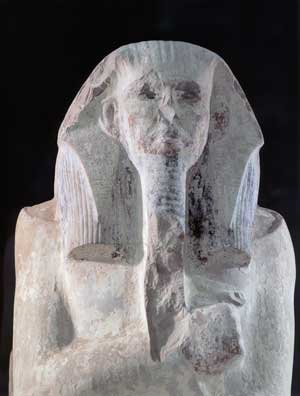
(Figure 8). The room contained
a beautiful painted limestone statue of
Djoser sitting on his throne (right).
Two holes had been bored at eye level so
that the king could see and smell the offerings
placed before him. |
| |
|
The
Mortuary Temple from the Northwest |
|
Seated
Statue of Djoser from the Serdab |
|
| |
| THE
ENCLOSURE |
| |
|
Entrance
to the Enclosure |
| |
| The
Entrance Colonnade |
| |
| The
stone walls which surrounded the site were about 10
metres high and were designed to mimic the mud-brick
walls of a royal palace with its niche-and-buttress
facade. Towers projected at 4 metre intervals on the
mile-long circuit and there were no less than fourteen
gateways, guarded by massive flanking towers. All of
these gates except for one were false, however. The
only actual entrance lay near the southern end of the
eastern wall (Figure
9). The gate led to a long passage lined
with 40 pairs of attached columns, carved with flutes
to resemble bundles of reeds. The columns formed alcoves
which may well have contained statues of the pharaoh.
At the end was a small transverse vestibule with eight
lotus-bundle columns to support the ceiling. A doorway
led into the Great Court
(Figure 10). |
| |
|
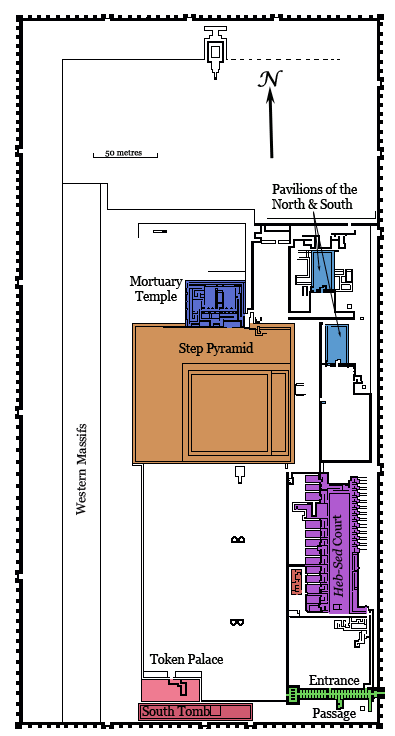
Ground
Plan of the Djoser Complex |
| |
| The
Great Court |
| |
|
Aerial
from the South, showing the South Tomb, Token Palace,
Great Court and Step Pyramid |
| |
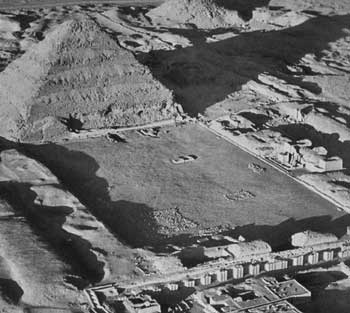
| The
Great Court (Figure
11) was an area 187 x 108 metres,
enclosed by ‘palace facade’
walls. There was a raised throne dais with
a ramp just like that depicted on
Den's label on the northern edge,
right next to the pyramid. Near the centre
is a pair of horseshoe-shaped cairns—
presumably the equivalent of those depicted
in the reliefs and on the Den label. In
this case, however, they were for the use
of the soul of the deceased king, his
'ka. |
| |
| At
the south end of the courtyard was a Token
Palace
(Figure 12), a stone representation
of the pavilion where the king rested and
refreshed himself during the ceremonies.
Like all of the replica buildings in the
funeral complex, it was designed for |
|
Horseshoe
Markers at the north end of the Great Court |
|
| the
'ka which meant there was no need for actual
rooms the spirit of the dead king could pass through
walls. The essential requirement was permanence, since
they had to last throughout eternity. |
| |
| The
Southern Tomb |
| |
| In
the southern end of the Great Court sits
a structure known as the Southern Tomb.
It was a long building with a low, vaulted
roof and an internal arrangement much like
the substructure of the pyramid. The burial
chamber was at the bottom of a shaft 30
metres deep and was made out of the same
pink marble, but in this case it was tiny,
barely 1.5 x 1.5 metres hardly big
enough to have held a body and a coffin.
More likely it held ‘canopic jars’
containing the embalmed viscera of the king.
It was surrounded by galleries and passages
decorated with the same sorts of faience
mosaics that are found in the pyramid. They
are designed to represent corridors and
rooms within some sort of building made
out of reed mats— perhaps the royal
palace itself. There are stone doorways
with rolled up mats serving as doors
even the backs of the doorways are shown!
(Figure
13) |
| |
| One
of the ‘doorways’ frames a relief
showing Djoser taking part in his jubilee
(heb-sed). This ritual was held,
according to later accounts, after 30 years
on the throne and then every three or four
years after that. It is generally believed
that the ceremony was instituted to replace
the ritual killing of the |
|
Shaft
of the Southern Tomb |
|
|
king when his strength and virility began to fail, a
practice attested in pre-colonial Africa. |
| |
| An
important part
of the ritual apparently involved the king
emerging from a raised pavilion and running
or dancing between horseshoe-shaped markers.
The ritual was known as ‘encompassing
the field’ and was the means by which
the pharaoh established his claim to the
kingdom, by beating its symbolic boundaries. |
| |
|
Ebony
Label showing the Heb-Sed of the Dynasty
I pharaoh, Den |
| |
| The
actual ceremony took place at the palace
of the king, in a special field designed
for the purpose and provided with various
platforms, pavilions and shrines. The buildings
were all constructed in the traditional
manner, out of reed matting and supported
by bundles of reeds. Of course none of these
original structures would have |
|
Djoser
‘encompassing the field’ |
survived,
so it is fortunate that Djoser and Imhotep built a stone
version so that the pharaoh could perform the ritual
in perpetuity in the afterlife. |
| |
| The
Heb-Sed
Court |
| |
|
In addition to the Great Court, there was another important
ceremonial area connected with the king's jubilee located
within the complex. To get there, you took a rather
circuitous set of passages near the beginning of the
Entrance Passage. The courtyard was lined with dummy
chapels of two distinct types, representing those common
to Upper and Lower Egypt. |
| |
|
Heb-Sed
Court and Step Pyramid |
| |
| Most
of the buildings along the west side have a convex roof,
typical of Delta shrines, supported by three engaged
columns. The building copies the appearance of a reed
hut supported by papyrus stalks the columns have
pendant leaves at the top. The typical Valley temple
was a simple, rectangular structure supported by bundles
of reeds at the corners ‘'toros-moulding’).
The tops of the reeds were allowed to droop over, forming
what is known as a ‘cavetto cornice’ (Figure
14). The stone replicas were pretty much
solid masonry with rubble cores, apart from small chambers
inside the false doors. Each had a niche for a cult
statue and a small courtyard where sacrifices took place.
They represented the temporary shrines which were erected
for the king's heb-sed ceremony so that he might
sacrifice to the gods of all parts of his kingdom. At
the south end of the courtyard was a large throne dais,
large enough for a pair of thrones, where the pharaoh
would be crown twice in ceremonies for the north and
south. Around the corner, over by the edge of the Great
Court, was a small stone pavilion called the ‘Robing
Hall’ (Figure
15) representing the pavilion where
the king rested between ceremonies. |
| |
| The
Palaces of the North and South |
| |
|
The
House of the South |
| |
| These
large rectangular buildings lie to the north of the
Heb-Sed Court, along the east side of the enclosure.
They were also patterned on reed structures and were
very similar to the convex-roofed shrines of the Heb-Sed
Court. They were ‘supported’ by 4 tapering
engaged columns with large pendant leaves for capitals
and square sockets to peg some sort of emblems. A frieze
representing a rope of knotted grass (khekher)
ran across the lower part of the facadethe asymmetrically
placed door was ‘hung’ from this.
(Figure 16). These probably represented
the palatial residences of the ka. Like the rest
of the buildings in the complex, they were pretty much
solid although there was a small cruciform chamber.
Each palace sat at the rear of its own, somewhat irregularly-shaped
courtlardthe one belonging to the Southern Palace
is larger and contained the remains of a horseshoe-shaped
cairn, suggesting a ritual use. There was a shallow
niche in the wall of the North Court which contained
three engaged papyrus columnsa similar niche in
the South Court presumably had lotuses. |
| |
|
Engaged
Papyrus Columns in the courtyard of the Palace of
the North |
| |
| The
Northern Court |
| |
| Between
the pyramid complex and the northern end of the enclosure
was a large open area known as the Northern Court. Its
specific purpose is unknown and work apparently came
to an end before it was finished, probably due to the
death of the king. There is a stone altar at the northern
end, facing the pyramid. Underneath the alter were a
number of subterranean galleries containing agricultural
productsgrape pips; sycamore figs; and grain have
been found. Other galleries, largely unexplored, lay
beneath the long terraces along the western side of
the enclosure. |
| |
Aerial
view of Saqqara showing Sekhemkhet's Pyramid
(2) and other enclosures (3& 4)
|
| |
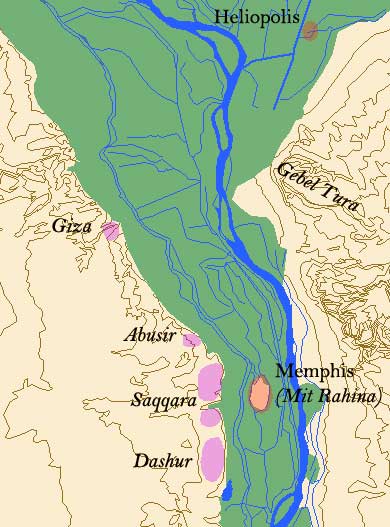
| Djoser's
son and successor Sekhemkhet built a similar complex
at Saqqara and there is evidence of at least two others
to the west. Another member of Djoser's dynasty, Khaba,
may have started the so-called ‘Layer Pyramid’
at Giza but with the rise to power of the Fourth Dynasty
the stepped form gave way to the ‘true’
pyramid. |
| |
| THE
AFTERMATH |
| |
| The
practice of building on a monumental scale became standard
among the pharaohs who succeeded Djoser and reached
its apogee in the Great Pyramid of Khufu at Giza. The
political benefits of such projects were obvious. “Idle
hands are the devil’s tools.” and the pharaohs
were well aware of the dangers of hundreds of thousands
of farmers with time on their hands while the Nile was
in flood. Not only did the pyramid project keep them
busy but it also put them on the state payroll making
them more dependent on the central government. |
| |
| The
logistical problems in a project of this scale were
unprecedented. Thousands of people needed to be housed
and fed. Material and supplies had to be moved from
all over Egypt to the building site. The creation of
a class of men who could handle such problems gave Egypt
the managerial resources to take on any large and complex
project— invading another country, for example,
or putting together a large trading expedition. In addition,
thanks to Imhotep, Egypt had a large pool of highly
skilled artists and artisans— stone masons, sculptors,
draughtsmen and painters. |
| |
| The
state put together by Djoser lasted for nearly 500 years
with little sign of internal strife. After reaching
its peak in Dynasty IV, the ‘pyramid industry’
was gradually wound down. The pharaohs of Dynasties
V & VI continuted to build them but on a much reduced
scale. Instead, much of the activity was diverted (as
far as the visible record shows) to the tombs of private
individuals. |
| |
| |
| Further
Reading: |
| |
| Lauer,
Jean-Philippe |
(1976) |
The
Royal Cemetery at Memphis |
| Lehner,
Mark |
(1997) |
The
Complete Pyramids |
|
| |
| ©
Odyssey, Adventures in Archaeology. 2008 |