The most commonly used system is a tripartite one devised by Evans and based on the stylistic changes in pottery observed at Knossos. Evans divided his material into Early, Middle and Late Minoan (usually abbreviated to EM, MM and LM) and each of these broad phases was in turn sub-divided into I, II and III. Subsequent research has led to a fine-tuning of the system and the introduction of further sub-divisions so that you can get pottery classified as LMIIIA2. The whole structure was linked to the well-known historical chronology of Egypt. Minoan pottery of a particular style might be found in the tomb of an Egyptian official who served a pharaoh whose dates are known or an Egyptian object with the inscription of a particular pharaoh might turn up in a Cretan context.
The system is not without its problems, however, and some of these are quite serious. In the first place, the sequence worked out for Knossos is not always applicable to the rest of the island—LMII pottery, for example, is exclusive to the Knossos area. Also, the major pottery phases do not always coincide with other developments in the archaeological record—the earliest palaces appear after the MMI period is well underway. So, recently, most scholars have opted for a broader system which better reflects the important social changes.
| Current Terminology |
Evans’ Pottery Styles |
Vessels |
| |
| Pre-palatial Period |
| (c. 3300-1900 BC) |
| |
There was a good deal of evidence of social complexity during this period— large settlements (some fortified), international trade and differences in status and wealth. There are elaborate tombs and wealthy burials but nothing that could be described as a palace. |
|
| |
| Early Minoan I— |
| Middle Minoan IA |
| |
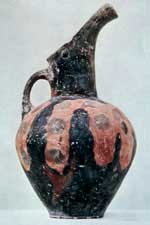
| There were a number of different styles of decoration, both painted and applied, during this period but the most distinctive is known as Vasiliki Ware after the site where it was first identified. The characteristic mottled effect was produced by deliberately uneven firing of the vessel in the kiln. The shape of the vessel shown at right is typical of the Aegean. |
|
 |
| |
| First Palace Period |
| (c1900-1700 BC) |
| |
| Palaces appear at roughly the same time at a number of different locations in Crete, apparently in response to social and political upheavals taking place throughout the East Mediterranean world. |
|
| |
| Middle Minoan IB— |
| Middle Minoan IIIA |
| |
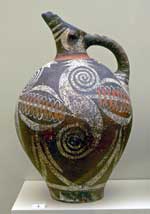
| During the period of the earliest palaces, the most easily identifiable pottery around was Kamares Ware, named after a cave near the palace of Phaistos, where they were first identified. Their striking polychrome decoration, with its vibrant clours is very easy to spot. Notice how the form of the vessel has changed along with the surface decoration. |
|
 |
| |
| Second Palace Period |
| (c. 1700-1450 BC) |
| |
| All of the old palaces in Crete were destroyed, evidently by a particularly severe earthquake. This event apparently did little to affect the social order, however, and the palaces were immediately rebuilt. |
|
| |
| Middle Minoan IIIB— |
| Late Minoan IB |
| |
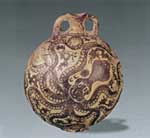
| As the palace period proceeds, a more naturalistic style of decoration appears— along with a number of new shapes, such as this 'stirrup jar' (right). A favourite was the so-called Maritime Style, in which the artist depicted various species of sea creatures and underwater plants. The octopus was a particular favourite. |
|
 |
| |
| Third Palace Period |
| (c. 1450-1200 BC) |
| |
| The onset of the third palace period is also marked by destruction but, in this case, it was man made. All of the palaces except Knossos were destroyed and abandoned. |
|
| |
| Late Minoan II— |
| Late Minoan IIIB |
| |
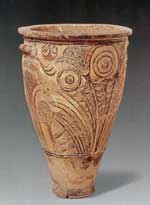
| The defining pottery of this period is the so-called 'Palace Ware' found at Knossos, which is much more formal and standardized than earlier styles. At right is a tall jar characteristic of the period |
|
 |
| |
| Post-palatial Period |
| (c. 1350-1000 BC) |
| |
| In the years that follow the final destruction and abandonment of Knossos, urban civilization disappears from the Aegean world. |
|
| |
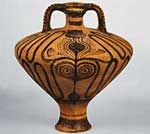
| Although many characteristic shapes continue into this period many new ones appear such as the stirrup jar shown at right. Decorative motifs are more stylized and less naturalistic than before. |
|
 |